Encoded in CellML by Moritz Linder
Institute of Biomedical Engineering, Karlsruhe Institute of Technology
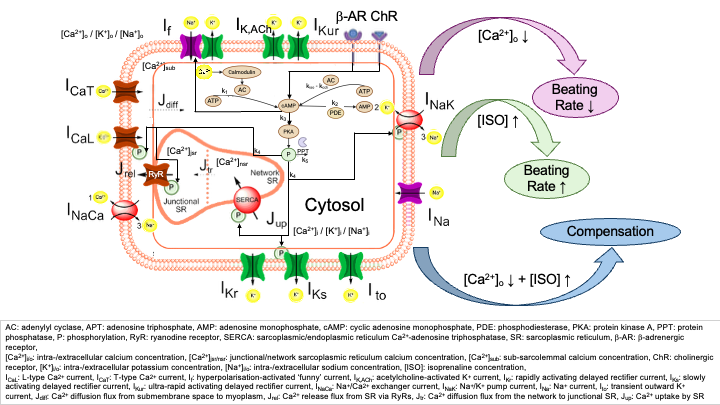
We extended the sinoatrial node cell (SANC) models of Severi et al. (rabbit) and Fabbri et al. (human) using the β-adrenergic receptor (β-AR) signalling cascade described by Behar et al.
Simulations were conducted across various extracellular calcium ([Ca2+]o) concentrations (0.6–1.8 mM) and isoprenaline concentrations [ISO] (0–1000 nM) to reflect conditions in haemodialysis (HD) patients.
An exponential-like increase in [ISO] compensated for hypocalcaemia-induced bradycardia in both models, whereas interspecies differences increased the sensitivity of the extended Fabbri model towards hypocalcaemia and increased sympathetic tone.
The extended models may help to further understand the pathomechanisms of several cardiovascular diseases affecting pacemaking, such as the high occurrence of sudden cardiac death (SCD) in chronic kidney disease (CKD) patients.
Regular activation of the heart originates from cyclic spontaneous depolarisations of sinoatrial node cells (SANCs). Variations in electrolyte levels, commonly observed in haemodialysis (HD) patients, and the autonomic nervous system (ANS) profoundly affect the SANC function. Thus we investigated the effects of hypocalcaemia and sympathetic stimulation on the SANC beating rate (BR). The β-adrenergic receptor (β-AR) signalling cascade, as described by Behar et al., was incorporated into the SANC models of Severi et al. (rabbit) and Fabbri et al. (human). Simulations were conducted across various extracellular calcium ([Ca2+]o) (0.6–1.8 mM) and isoprenaline concentrations [ISO] (0–1000 nM) for a sufficient period of time to allow transient oscillations to equilibrate and reach a limit cycle. The β-AR cell response of the extended models was validated against new Langendorff-perfused rabbit heart experiments and literature data. The extended models revealed that decreased [Ca2+]o necessitated an exponential-like increase in [ISO] to restore the basal BR. Specifically at 1.2 mM [Ca2+]o, the Severi and Fabbri models required 28.0 and 9.6 nM [ISO], respectively, to restore the initial BR. Further reduction in [Ca2+]o to 0.6 mM required 170.0 and 43.6 nM [ISO] to compensate for hypocalcaemia. A sudden loss of sympathetic tone at low [Ca2+]o resulted in a loss of automaticity within seconds. These findings suggest that hypocalcaemic bradycardia can be compensated for by an elevated sympathetic tone. The integration of the β-AR pathways led to a logarithmic BR increase and offers insights into potential pathomechanisms underlying sudden cardiac death (SCD) in HD patients.